
“How much is this going to cost?” is usually the first question that comes up on any land clearing project, and it’s a fair one. The honest answer is that it depends heavily on what’s actually growing on the property, how accessible it is, and what you need done once the vegetation is gone.
This guide breaks down general industry pricing patterns, the factors that push cost up or down, and the warning signs that tell you a property needs clearing before you build. The figures below are general, publicly reported industry benchmarks meant to help you budget and ask informed questions. They are not a quote from any specific company, and actual pricing always depends on the contractor, the region, and a proper site walk.
Typical Land Clearing Costs by Vegetation Type
Industry-wide, land clearing tends to fall into these general ranges per acre. These are broad national benchmarks pulled from publicly available cost data, not a fixed price list, since terrain, region, and labor rates all shift the real number for any given job.
| Vegetation Type | General Cost Range Per Acre |
|---|---|
| Light brush and grass | $600 to $2,000 |
| Moderate growth (shrubs, small trees) | $2,000 to $4,000 |
| Mixed woods | $3,500 to $6,000 |
| Heavy forest (large mature trees) | $5,000 and up |
These are general benchmarks, not a quote. Every property is different, and the only way to get a real number is a site walk. If you want an exact figure for your lot, request a free estimate and we’ll walk the property with you.
How Land Clearing Is Typically Priced
Contractors generally price land clearing one of three ways, and it’s worth understanding the difference before you compare quotes:
- Per acre pricing, which is most common for larger or more uniform properties and gives you a straightforward number to plan around
- Hourly pricing, which sometimes applies to smaller or more complex jobs where the time required is harder to predict upfront
- Flat rate or per-project pricing, which is common for small residential lots where a job minimum applies regardless of exact acreage
None of these methods is inherently better than the others. What matters is that the scope is clearly defined in writing, including whether stump removal, grading, and debris hauling are part of the quoted price or billed separately.
What Actually Drives the Price Up or Down
Vegetation density
This is usually the biggest factor in any land clearing estimate. Light brush clears much faster than mature trees, so denser growth means a higher price.
Tree size and stump removal
Cutting a tree down is one job. Removing the stump is often a separate cost. If you want a fully clean lot, ask upfront whether stump removal is included or priced separately.
Terrain and access
Steep slopes, wet ground, or hard to reach lots all add time and cost. Flat, easy to access land clears faster and usually costs less.
Hauling debris vs. processing it on site
Hauling cleared material away usually costs more than chipping or mulching it on the property, where it can sometimes be reused.
Permits
Many counties have rules around tree removal, especially on larger lots or land near protected areas. Getting permits approved can add time and cost, so it’s worth checking local rules before starting.
Getting equipment there and time of year
Getting equipment to a hard to reach site adds cost. Prices can also shift by season, since land clearing tends to get busier in spring and fall.
Signs Your Property Needs Land Clearing
Not sure if your property needs clearing, or just a regular cleanup? Here’s what usually points to a clearing job.
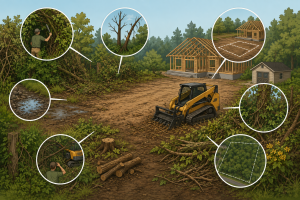
- Overgrown brush or vines block access, so you can’t even walk the property line without cutting through
- Dead or leaning trees stand near where you plan to build, which is a safety risk that needs handling first
- Water pools and doesn’t drain, since overgrown areas often trap water instead of letting it flow
- You’re planning any new build, like a home addition, driveway, or outbuilding, since the footprint usually needs clearing and grading first
- Invasive vines or fast growing shrubs are spreading and choking out healthy trees
- Crews can’t get equipment into the work area because of thick brush
- You recently bought land with no clear upkeep history, which often means years of growth need addressing before anything else can start
Land Clearing vs. Yard Cleanup
People sometimes confuse light yard cleanup with actual land clearing, and they’re not the same scope of work.
| Yard Cleanup | Land Clearing | |
|---|---|---|
| Scope | Leaves, small branches, surface debris | Trees, stumps, brush, root systems |
| Equipment | Rakes, blowers, mowers | Excavators, mulchers, chainsaws |
| Goal | Tidy up an existing landscape | Prepare raw or overgrown land for use |
| Typical trigger | Seasonal maintenance | New construction, overgrown lots, land purchase |
If your project involves anything beyond surface debris, like tree removal or grading a new building footprint, that’s land clearing, not cleanup. Our seasonal cleanup service covers the maintenance side if that’s really what a property needs instead.
Land Clearing and Permit Considerations
Regulations around clearing land vary widely by county and even by lot size within the same county. Forest conservation ordinances, wetland buffers, and tree protection zones can all affect what’s allowed, what requires a permit, and how much documentation a project needs before work can begin. This is worth researching or confirming with a licensed contractor early, since discovering a permit requirement mid-project can delay timelines and add unexpected cost.
DIY Land Clearing: Worth the Risk?
Renting equipment and doing it yourself can seem tempting for a small lot, but land clearing comes with real risks: falling trees, hidden slopes, unstable ground, and heavy equipment most homeowners aren’t trained to run safely. Debris disposal also adds up fast once you factor in hauling and landfill fees on top of the rental cost.
For anything bigger than a small patch of brush, a professional crew with the right gear and insurance is usually faster and safer, even after accounting for labor cost. It’s also worth checking if your homeowner’s insurance covers injury or damage from DIY equipment use, since many policies don’t.
Frequently Asked Questions
How long does land clearing typically take?
A smaller residential lot can often be cleared in a day or two under normal conditions. Larger or heavily wooded properties can take a week or more, depending on vegetation density, terrain, and equipment access.
Do I need a permit before clearing land?
It depends on lot size, tree coverage, and whether the property falls under local forest conservation or wetland regulations. Requirements vary significantly by jurisdiction, so it’s worth confirming with your local planning office before work begins. Permitting and site prep often overlap, and our grading and site preparation page covers how that process generally works once clearing is complete.
Is stump grinding automatically included in a land clearing quote?
Not always. It’s often quoted as a separate line item from tree and brush removal, so it’s worth confirming exactly what’s included, and what counts as extra, before comparing quotes. Our land clearing page breaks down what’s typically covered in a standard job.
What’s the difference between land clearing and grading?
Clearing removes what’s growing on the land. Grading levels and shapes the ground underneath afterward so it’s suitable for building, drainage, or landscaping. Most build-ready projects need both, usually in that order. Our grading and site preparation page explains how the two typically fit together on a project.
What happens to the land after it’s cleared? Do I need other services next?
Once a lot is cleared, most homeowners move on to grading, followed by either construction or new landscaping, depending on the goal for the property. If any individual trees near the cleared area still need attention, that typically falls under tree work rather than full clearing. And once the land is ready for planting, our landscaping services can help turn a cleared lot into a finished yard.
Get an Accurate Quote for Your Property
General cost guides only get you so far. If you’ve got a specific lot in mind, the fastest way to a real number is a site visit from a licensed contractor who can assess vegetation, terrain, and access in person. We handle land clearing across Montgomery County and the surrounding service areas, and we’re happy to walk your property and give you a straight answer on cost and timeline. Contact us or call (240) 620-2749 for a free estimate.